Blog › Owner Statements
Owner StatementsAirbnb Owner Statements with Smoobu: Error-Free Monthly Reporting
Every month, the owner statement is the one document most of your property owners actually read. They don't see the work that goes into managing bookings, coordinating cleaners, or answering guest messages at midnight. They see a number: the amount landing in their account, and how it was worked out. One confusing statement, one commission mistake, or a payment that arrives three days late, and the trust behind the whole relationship starts to wobble.
Yet producing a clean owner statement is far from trivial once you're managing more than two or three properties — and it gets harder still when your bookings flow through a channel manager like Smoobu, which centralises the data beautifully but was never built to format it for your owners.
The short answer: connect Smoobu and you're done
Before getting into why this calculation is trickier than it looks, let's cut to the point: once your properties are connected to Smoobu, Trackivo automatically imports every booking and calculates each property's owner statement — platform commissions, local tax, owner's share — with no re-typing and no spreadsheet. Connect your API key once, and every monthly reporting cycle after that becomes a matter of a few clicks rather than days of work.
The rest of this article looks at why this calculation goes wrong so easily by hand, then walks through exactly how Trackivo handles it once it's connected to Smoobu.
Why owner statements are more complex than they look
On paper, the maths looks simple: the owner receives what the platforms collected, minus your management fee and cleaning costs. In practice, every line hides a potential mistake.
Commission rates differ by platform: Airbnb, Booking.com and direct bookings each apply different rates and different payout rules. A property booked half through Airbnb and half through Booking.com needs a separate calculation for every single booking — not a rough average across the two.
Then there's local tax: VAT, IGIC in the Canary Islands, tourist tax depending on the location. Some fee lines are taxable, others aren't — your management fee usually is, an item you bought to help out a guest usually isn't. Get one line wrong and the whole statement total is off.
And there's the business model itself: do you collect the payment yourself and pass on the owner's share afterwards, or does the owner collect directly while you invoice them for your services? Both models exist depending on the contract, and the resulting document — a payout on one side, a services invoice on the other — looks completely different and uses different legal wording.
The real hidden cost: time
When this is done by hand in a spreadsheet, the calculation itself is only the visible part. First you have to pull the month's bookings from your PMS or straight from the platforms, copy them across, double-check nothing was missed or double-counted on a stay spanning two months, apply the right commission rate to every line, add any extra charges, work out the tax, and then format the whole thing into something presentable — before emailing it out, one owner at a time.
For a concierge business managing fifteen or twenty properties, this monthly cycle can eat up several days of repetitive work. Time that's neither billable nor rewarding, and that leaves plenty of room for a copy-paste error to slip in at the worst possible moment: right when the owner is comparing your number against their own.
Take a concrete example. A property rented for twelve nights in a month: seven nights via Airbnb at €150 a night with a 15% commission, three nights via Booking.com at €140 with a 17.4% commission, and two nights booked directly with no platform commission at all. For this property alone, working out the payout amount, your management fee, the cleaning fee and the IGIC that applies only to your own services already takes seven separate calculations. Multiply that by fifteen properties, some with individually negotiated rates, and the whole exercise quickly turns into the kind of task that gets pushed to next weekend — at the risk of sending statements late.
Owner statements and Smoobu: what syncing actually changes
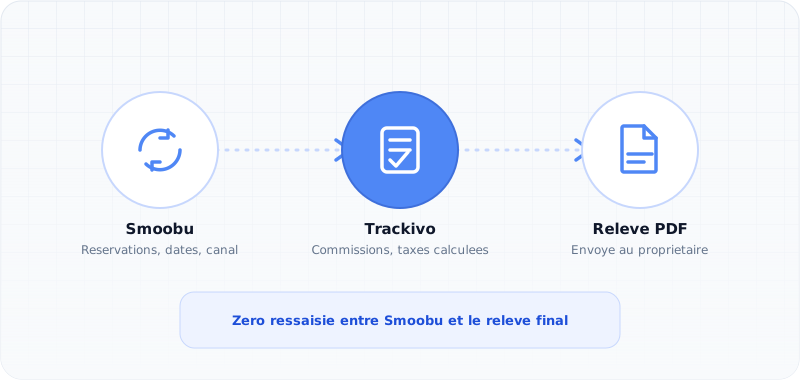
Once your properties are connected to Smoobu via an API key, every booking — whether it came from Airbnb, Booking.com or a direct reservation — already arrives tagged with its source platform, dates and amount. Trackivo reads these bookings directly instead of asking you to re-enter them: at the start of each new month, every stay for the property is imported automatically, with the correct platform attached to each line.
It's this piece of information — the booking's actual platform, exactly as synced from Smoobu — that lets Trackivo apply the right commission rate automatically, booking by booking, without you having to manually check where each stay came from. For a concierge business running fifteen properties through Smoobu, that's fifteen properties' worth of calculations that no longer need checking by hand every month.
Smoobu handles your bookings, not your owner statements
Smoobu is, first and foremost, a channel manager: its job is to keep your calendars and prices in sync across Airbnb, Booking.com and the other platforms — not to produce a reporting document for your owners. Turning Smoobu's data into a clean owner statement — applying the right commission rate per platform, adding local tax, clearly separating the owner's share from your fees, and formatting it into a presentable PDF — is work Smoobu simply isn't built to do.
That's exactly the gap Trackivo fills: you keep using Smoobu to run your bookings and availability, and Trackivo takes over everything to do with calculating and sending the owner statement, working from the same data that's already synced — no double entry, no manual export-import between the two tools.
What makes a statement reassuring
A good owner statement isn't just accurate. It needs to be readable and checkable at a glance: the booking-by-booking detail, the commission applied per platform, and a clear split between the owner's share and what stays with your concierge business. An owner who can trace every line themselves asks fewer questions — and trusts the final number more.
Consistency matters too. Receiving your statement on the same day every month, in the same format, with the same level of detail, is a signal of professionalism that's almost as reassuring as the figure itself.
How Trackivo automates the whole process
Trackivo was built to strip out the manual, error-prone parts of this job. Bookings are imported automatically from Smoobu every month, with no re-entry required. Commission rates per platform (Airbnb, Booking.com, direct booking, or a custom platform) are set up once — either across the board or per property, if an owner has negotiated different terms — and then applied automatically to every booking. If a booking comes in from a platform that isn't recognised in your settings, an alert badge blocks the PDF from being generated instead of letting a wrong calculation slip through.
Both business models are supported natively: paying out the owner's share, or invoicing for your services, each with the wording and layout that fits. Local tax (VAT, IGIC) is configured once and applied line by line according to your settings.
The final statement is generated as a professional PDF, ready to send with one click — or in bulk to every owner at once — from your own email address. Each owner also gets a personal white-label portal where they can find the full history of every statement, without ever needing to ask you for it.
The result: what used to take several days a month now takes a few clicks, with zero calculation errors and a document that builds trust at first glance.
The check worth keeping, even with an automated tool
Before sending a statement, a few quick checks are enough to head off the most common dispute with an owner: does the number of nights billed actually match the stay as it really happened over the period (stays spanning two months being the number-one source of error); does the commission rate applied match the booking's real platform rather than a rough average; and are any extra charges on the statement backed by a receipt the owner can look at if they ask. Automating the calculation doesn't remove the need for this final check — it just makes it far quicker to do.
Ready to simplify your concierge business?
Try Trackivo free for 14 days, no credit card required.
From €29.90/month · No commitment