In an Airbnb concierge business, the most valuable asset isn't the management software, or even the property portfolio — it's owner trust. It's an asset that's built slowly, over months of consistent statements and quick responses, and that can crack after a single bad experience. An owner who doubts how their income is being calculated, who has to chase you by email for an old statement, or who only finds out something about their own property when they call to ask, will sooner or later start asking a question that's dangerous for you: "would I earn just as much managing it myself?"
It's a topic that's surprisingly under-covered in the content out there on running a concierge business — most resources focus on winning new listings, far fewer on keeping the ones you already have. Yet losing an owner over a lack of transparency usually costs more than winning a new one.
The short answer: a portal built on your own Smoobu data
Let's cut to the point: as soon as your properties are connected to Smoobu, Trackivo automatically generates a personal, white-label portal for every owner, giving them the complete history of all their statements — no extra setup on your part, and no data to re-enter.
The rest of this article looks at why transparency is such an underrated retention lever, then walks through exactly how this portal is built from the data already synced from Smoobu.
The problem of opacity, even when it's unintentional
Most concierge businesses aren't opaque by choice. They're opaque by default, because the information stays scattered: a statement emailed out once a month, an access request that takes two days to fulfil, a history of statements you have to dig up from a cluttered inbox. The owner has no simple way to check for themselves that everything is in order — they either have to trust you, or come to you and ask.
That dependence on your availability creates a steady stream of low-value back-and-forth: "can you resend March's statement", "where are we with this month's numbers", "can I get a summary for the year". Every one of these questions is entirely fair — and every one is also time you're not spending growing the business.
Take a common case: an owner with two properties in your portfolio, managed by different people on your team over time, asks you for an annual summary for their tax return. Without a centralised, accessible history, pulling together twelve statements across two properties can eat up the better part of an afternoon — searching through emails, checking nothing's missing, reformatting everything. With permanent access, the owner finds it all themselves in a few seconds, without asking anyone.
What changes with permanent, self-serve access
A dedicated owner portal flips the logic: instead of waiting for information to be sent to them, the owner accesses it whenever they want, through a permanent link that never changes and needs no account to be created. They get the full history of their finalised statements, can download any PDF whenever they like, and — a point that's often overlooked — if they own several properties with you, everything sits under one single login.
The white-label side of it isn't a cosmetic detail. A portal showing your concierge business's name and logo, with no visible mention of a third-party tool, reinforces your professionalism in the owner's eyes — it's your brand they remember, not your software's. A portal that visibly looks generic, with a software vendor's name front and centre, does the opposite: the owner is more likely to credit the value to the software than to you, which chips away at how they see your own expertise over time.
A retention argument, and a sales argument
Transparency has a direct effect on retention: an owner who can check every line of the calculation themselves, whenever they want, has far fewer reasons to doubt how you're managing their property. It's also a concrete selling point when signing a new listing: being able to say "you'll have your own personal space where you can track your income in real time" reassures a hesitant owner far more effectively than a verbal promise of transparency ever could.
Owner portals and Smoobu: where the numbers actually come from
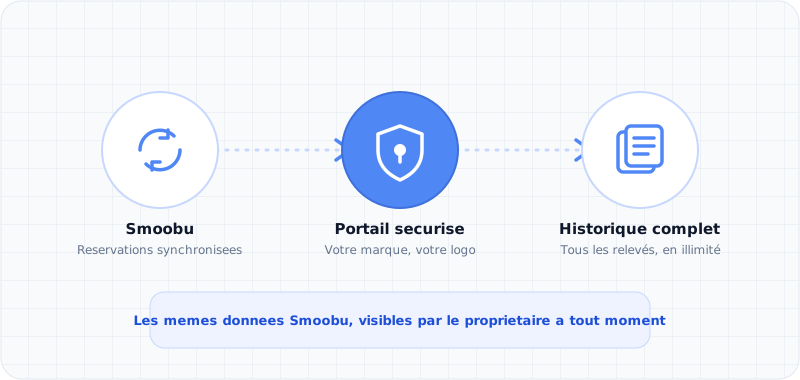
Trackivo's owner portal doesn't show numbers that were typed in by hand: it displays the same statements calculated from bookings synced automatically from Smoobu. As soon as a property is connected to Smoobu, its Airbnb, Booking.com and direct bookings flow into Trackivo, feed into the monthly statement calculation, and then appear exactly as they are in the owner's personal space.
That means there's never a gap between what your Smoobu PMS shows and what the owner sees in their portal — a single data flow, from the booking calendar all the way to the owner's space, with no re-entry step where an error could creep in.
What Smoobu doesn't offer: a dedicated space for your owners
Smoobu is a tool built for you, the manager: syncing channels, centralising bookings, adjusting prices. It doesn't include a space aimed at your property owners, with their own statement history, in white label, accessible without creating an account — that's simply not what the tool was designed for.
That's the gap Trackivo's owner portal fills: you keep Smoobu for what it does well — managing bookings and distribution channels — and you give each owner access built specifically for them, powered by the same data that's already synced.
How Trackivo builds this portal automatically
In Trackivo, a permanent access token is generated automatically for every owner the moment their first statement is finalised — no technical setup required from you. If the same owner has several properties in your portfolio, they all appear grouped under that same single login.
The portal shows only your name, your logo and your colours — no visible mention of Trackivo, aside from a discreet "powered by" line in the footer. The owner finds every finalised statement there, sorted by property, downloadable as a PDF at any time. The link can be resent in one click from the property's page, and it's automatically included in every statement email you send — the owner never has to ask you how to get to it.
The result: fewer low-value administrative exchanges, and a trust-based relationship built on verifiable facts rather than promises.
A detail that matters when winning a new listing
For an owner weighing up self-management versus a concierge business, or choosing between two competing concierge businesses, transparency becomes a tangible argument rather than just a stated intention. Being able to show, right from the first meeting, exactly what their personal space will look like — the statements they'll find there, how easy it is to access, and how little they'll ever have to do themselves — speaks directly to the main hesitation most owners have before handing over their property: the fear of losing visibility over their own income.
Ready to simplify your concierge business?
Try Trackivo free for 14 days, no credit card required.
From €29.90/month · No commitment