Blog › Arrival Guide
Arrival GuideDigital Airbnb Welcome Guide with Smoobu: Managing It Across Every Property
The laminated welcome binder on the coffee table, wifi password scrawled on in pen, has had its day. Guests reach for their phone long before they'd open a binder, and a link sent automatically at check-in is far more convenient than a physical document that's out of date the moment the router password changes.
Digital welcome guides are already a well-covered topic online, with plenty of free templates and checklists of what to include. What's missing is an answer to the real question facing a concierge manager who's already running bookings through Smoobu: how do you do this properly not for one property, but for ten, twenty or thirty at once — without it turning into a full-time job.
The short answer: one guide per property, linked to your Smoobu messages
Let's get straight to it: Trackivo lets you build a complete arrival guide for every property, organised, duplicated in one click, and automatically translated into six languages, with a permanent link that slots straight into the messages you've already set up in Smoobu. No need to build a separate system or re-enter everything property by property.
The rest of this article explains why this quickly becomes unmanageable by hand once you're past about ten properties, then how Trackivo simplifies it day to day.
What a good arrival guide needs to cover
The content of a solid arrival guide doesn't vary hugely in structure from one property to the next: the precise address and easy directions (ideally with a map), how to get in (lockbox code, keypad, key handover), wifi, the alarm if the property has one, parking, useful emergency numbers, and possibly some local recommendations. It's fairly stable content, which makes it a good candidate for structure and automation.
The real challenge is scale, not content
Putting together a polished arrival guide for a single property takes an hour, maybe two. The problem shows up once you have to do it thirty times over, and then keep it all up to date: a keypad code changes, a new recycling rule comes in, a plumber's number is updated. Without a dedicated tool, updating one piece of information shared across several properties — an emergency number, say — means reopening and editing every single document one by one.
The second challenge, specific to tourist areas with an international clientele, is translation. A useful guide needs to exist in at least French, English and Spanish to cover most guests — ideally in whichever language each guest actually picks, not just the owner's. Translating that content and keeping it up to date by hand, across thirty properties and several languages, simply isn't realistic.
The third point that often gets overlooked is delivery. An arrival guide is only useful if the guest receives it at the right moment, through a channel they're already checking — typically the automated message your PMS sends at booking or check-in, rather than yet another email they have to go dig up.
Take a concrete example: a concierge business with twenty properties spread across two neighbouring towns. The router password changes with the internet provider across the whole portfolio. Without a centralised tool, that means reopening twenty documents one by one, potentially in several languages each — up to eighty edits for a single piece of information that, in reality, only changed once. The risk isn't just wasted time: it's forgetting one or two properties, only discovered when an annoyed guest reports they can't get online.
What an arrival guide built for scale needs to do
For a concierge business managing several properties, the ideal tool needs to let you build one template guide and then duplicate it to other properties while keeping the same structure (which sections are enabled, and in what order), while still letting each property keep its own specific content — a property's address and access code obviously have no business being copied onto another. Information shared across the whole business, like emergency numbers or default check-in times, should be set once, with the option to customise a specific property whenever needed.
Translation needs to be automated rather than manual, and the link to the guide needs to slot directly into the automated messages already being sent to guests, with no extra step on your part.
The Trackivo guide link in your Smoobu messages, with nothing to change in your templates
If you're already using Smoobu to send automated guest messages, your templates don't need any changes at all. The link to the Trackivo arrival guide slots into the welcome message Smoobu already sends for every booking, set up once per property rather than for every stay. The guest gets the usual automated message, clicks the link, and lands straight on their Trackivo guide, in the language they've chosen.
This is set up once, when the property is first created in Trackivo — not for every booking or every message — and it stays valid for as long as the property exists, even as the content behind that same link keeps evolving.
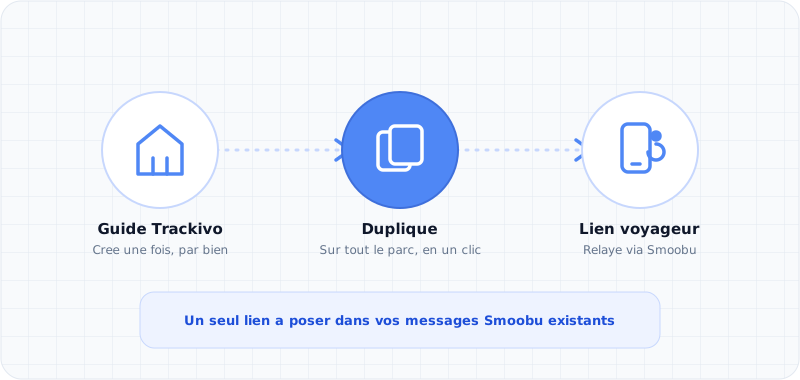
A guide organised by property, easy to duplicate across your whole portfolio
Beyond the link sent to guests, it's the guide's internal organisation that makes the real difference at the scale of a concierge business. Each property has its own guide, clearly attached to its own record, with no risk of mixing up access codes or recommendations between two different properties — even when several properties share the same building or neighbourhood.
Take a concrete example: a concierge business gradually adding twelve new studios in the same building to its portfolio. Rather than starting from scratch for each one, it duplicates the template guide already built for the first studio, and only needs to adjust two or three fields specific to each unit — the door number, the key-box code. The building's shared wifi, communal parking, emergency numbers and neighbourhood recommendations stay identical automatically, with no need to re-enter them twelve times over.
How Trackivo manages the arrival guide at the scale of a concierge business
In Trackivo, every property has its own arrival guide, made up of built-in sections (address, access, parking, alarm, wifi) that you switch on or off depending on the property's setup, plus unlimited custom sections — text or photos — for anything specific to that property: recommendations, particular equipment, special instructions.
Duplication lets you copy a guide's structure to one or several other properties in one click, without ever overwriting the content specific to each property — the address, access codes and hours always stay those of the target property. Settings shared across the whole business (emergency numbers, default check-in and check-out times) are configured once and apply everywhere, with the option to override them property by property.
AI-powered automatic translation covers six languages (French, English, Spanish, German, Italian, Portuguese) with a single "Translate all" button — every guest sees the guide in the language they've chosen. Every guide comes with a permanent public link, ready to drop into the automated messages already set up in your PMS.
The result: a professional, up-to-date arrival guide on every one of your properties, without managing it becoming a full-time job.
What it changes from the guest's point of view
A well-designed guide doesn't just make your own life easier internally — it also cuts down, quite mechanically, the number of messages you get on arrival day: "what's the wifi password", "how do I get in if you're not there", "where can I park". For a team handling several check-ins on the same day, every question headed off in advance is one less interruption during the busiest hours of the day.
Ready to simplify your concierge business?
Try Trackivo free for 14 days, no credit card required.
From €29.90/month · No commitment